Jump to a product
ENG
ITA
FRA
DEU

Date:
march 2009

Author:
Peecker Sound
Research dept

News
  Mar 09 - Jun 09 - Sep 09 >>
Different "SOUND PRESSURE ZONES"
inside the same venue
The evolution of the modern world and the rules of civil coexistence increasingly demand environments with various levels of "sonic emotions"; that is, with different levels of SPL (Sound Pressure Level). This enables various activities to take place without drastic physical separations between the spaces. Discotheques, for example, are increasingly dividing the overall space into a dance zone, a refreshment area (bar), the lobby, the meeting area, the games zone, and so on, instead of a single, huge area with extremely high decibel saturation. The greatest comfort for patrons and, consequently, the best management of the venue depend on being able to create areas with different sound pressure values according to the activity taking place there.


Fig. 1

New methods of design
Once upon a time, audio systems were designed with the single objective of creating the right sound level on the dance floor to induce club-goers to dance and provide the excitement of listening to their favourite tunes. What happened in the rest of the venue was not under control. Since we now require different levels, audio engineers have come up with all sorts of "creative" ways to position the acoustic speakers.
The results have been disappointing, and mainly limited to creating aesthetic solutions that may be more or less pleasing, but the substance of the problem remains unresolved, namely, the difference between the sound level on and off the dance floor remains quite small. As can be seen in Fig. 1, the red zone (high SPL) is in any case too large.

Standard loudspeakers
There are only two ways to resolve the problem:
a) create architectural barriers;
b) use directional loudspeakers.

The first method is not widely practised, is not very pleasant and is often ineffective, as it cannot sufficiently isolate the lowest notes, which tend to propagate in all directions.


To understand the second method, we observe the behaviour of a loudspeaker in the three classic frequency ranges (low, middle and high - Fig. 2). As you can see, the loudspeaker is always quite directional at the high frequencies, while it tends to irradiate in all directions the more it moves towards the low frequencies. All this harms the quality of the sound perceived outside the axis of radiation, but in particular it causes the sound level to remain high everywhere, despite the efforts of the engineers to orient the speakers in the most effective way. Single loudspeakers or traditional cabinet speakers - oriented as desired - cannot "physically" create zones with a high sound concentration alternating with others that are quieter.

In fact, there are only three types of audio systems that make it possible to direct the sound towards certain zones, while "toning down" others:
A) horns;
B) long arrays;
C) double arrays.
Let's take a look at them.

A) The first method is as old as civilization, as it was the ancient Greeks, always confronting the problems of theatres destined to hold large audiences, who noted that the voice could be reinforced and given greater directionality by applying rudimentary funnels or cones to the mouths of the actors or orators. At the turn of the 20th century, horns enjoyed great popularity with Edison's phonographs, but we had to wail till the 1980s to experience the first systems with "constant directivity and extremely high quality of reproduction". In other words, while the old horns produced sound effectively only on the axis and immediately became "closed" and "boxy" if you listened off-axis, the most modern devices, called Constant Q, maintain constant reproduction on a certain angle.But you have to pay attention to the physical limitations: horns function well as long as the dimension of the mouth is greater than the wavelength emitted. If, for example, you want a horn that is effective up to 1000 Hz, it needs a mouth of 34 cm diameter (equal to the wavelength of that frequency). If you also want to reproduce low frequencies using a horn, it would have to be of "monstrous" dimensions: a whopping 2.7 m diameter in order to go down to 40 Hz!


Fig. 3

Fig. 3 shows a dance floor system using a pair of horns. The true limitation of the first directional system (A) lies in the excessive physical dimensions, while the Constant Q principle of reproduction with horns remains fundamental for middle and high frequencies.

B) The term array refers to a sequence of the same type of elements arranged in a line; an acoustic array is thus nothing more than a line of the same type of loudspeakers.


Fig. 4

To understand the reason for such an arrangement, we begin by observing only two loudspeakers (Fig. 4b). The polar diagram narrows with respect to a single transducer (Fig. 4c), for the simple reason that while on the axis the two add up perfectly, off-axis one appears slightly out of phase with respect to the other. As the number of loudspeakers increases, the system becomes more and more directional. A line of many loudspeakers (array - Fig. 4a) represents a directional sound source, which is thus able to create zones at higher sound intensity near others with less intensity.


Fig. 5

To fully understand the quality of acoustic systems, without the biased influence of salesmen, we just need to examine the incontrovertible laws of physics. Let's see what happens when we have a very long array (Fig. 5), the so-called dispersed array. The listener receives a series of equal signals, with gradually decreasing amplitude, at intervals of time ∆t. If, for example, the distance between the loudspeakers is 60 cm, the interval of time will be 1.7 ms and will definitively jeopardize the intelligibility of the signal. The sound generated by these long arrays, though well concentrated on the dance floor, would be muddled and unpleasant.

C) Having numerous loudspeakers of small dimensions, but with large power, one next to the other, you create an array of small dimensions (double array) that is highly effective. Why does this array work, while the long one doesn't? Because in this case the distance between the speakers is only 15 cm, so the difference in the arrival time of the various signals is only 0.43 ms, corresponding to a frequency of 2286 Hz, which should not be reproduced by the array itself.

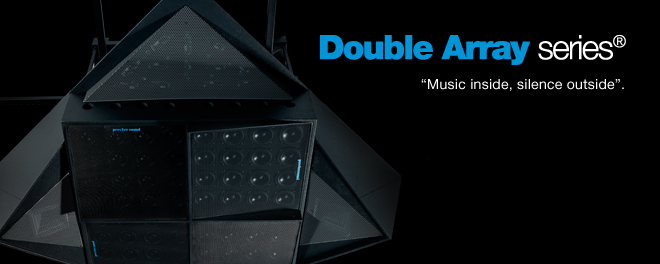
Peecker Sound has designed a number of arrays of this type (the AS60, AS120 Crossfire and AS180 models of the Double Array Series) using a two-way system, with a constant directivity horn in the mid-high range and a woofer in array for the low and mid-low frequencies. In all these Peecker Sound systems, the critical frequency of 2286 Hz is not reproduced by the array - which would create confusion -, but by the constant directivity horn. These speakers have been designed to concentrate the sound energy to the greatest degree in a certain area and to exploit the highest level of electro-acoustic technology: arrays of highly directional loudspeakers for the low frequencies and constant directivity waveguides for the middle and high frequencies.
The sound will be undistorted, intelligible and exciting, but - above all - properly directional, as desired at the outset.


Photo Gallery
Related products
» AS6

» AS60

» AS120

» AS180

Request info - Site map - Feedback Terms of use - Privacy policy - Credits
Peecker Sound is a registered trademark property of Sound Corporation. Sound Corporation. ©2011 Sound Corporation group.
All rights reserved.